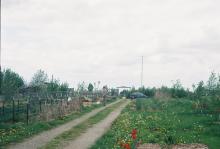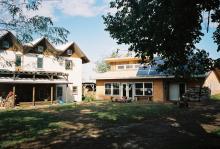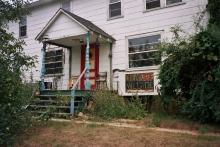
Dancing Rabbit Ecovillage, Missouri
I've visited Dancing Rabbit half a dozen times since 2004.
View an album of photos from my visits to the ecovillage.
- Read more about Dancing Rabbit Ecovillage, Missouri
- Log in to post comments
I've visited Dancing Rabbit half a dozen times since 2004.
View an album of photos from my visits to the ecovillage.
Dreamtime Village is an aspiring ecovillage in the unincorporated town of West Lima, WI. The former school and a number of surrounding buildings were purchased at auction by a community of artists from nearby Madison, and they proceeded to decorate the buildings without first evaluating them for structural integrity or safety. When asbestos was found in the school a few months later, they had to abandon the building, and when I visited in 2004 it was being reclaimed by nature, murals and school buses and all. I didn't take nearly enough photos.
In June of 2017, I gave an informal tour of our urban farm for a few members of the local garden club. In addition to my voice, you'll hear my wife Jessie and local farmer Tim Nicklin. Rather than record it as a video, I've made a slideshow to accompany the audio using photos from all 9 years we've lived here, as well as some from the weeks after the tour took place. See the slide descriptions for the timestamps when they are described in the audio.
Important: Read this retrospective before attempting to build this design.
In my previous article, Rethinking keyhole beds and mandala gardens, I demonstrated that the circular horseshoe shape celebrated in permaculture as being mathematically and ergonomically optimal
In August, 2008, we moved into our house on a 1/10 acre lot, and I began gardening with a single sheet-mulched plot in the front yard. I took a baseline set of soil tests from the front and back yards in January, 2009 and began a regimen of no-till, no-spray (i.e. no chemical amendments), no-manure gardening, using only plant-based mulch to maintain soil fertility while harvesting as many as 75 crops for market each growing season. The soil tests were done by our local university extension agency.
Soil preparation is not as important for native plants: they like the soil the way it is! Some even like to be stressed. Try growing them in cracks between landscape elements.
Wildflower meadow gardens are great for pollinator habitat, but study your site first. Consider microclimate and choose plants accordingly. Contrasting white flowers can help break up the uniformity of a meadow garden.
Here are the slides for the presentation I'm giving this afternoon at the Oklahoma Native Plant Society's Indoor Outing: